A comparative opening
Choosing an amorphous silica powder for a given commercial or industrial task proves oft a question of priorities: reinforcement versus flow, clarity versus cost, rapidity of wetting versus longevity of cure. The reader bent on rubber compounding will note differences at once; for elastomeric matrices, a correctly matched silica filler for rubber alters modulus, abrasion resistance, and processability more than many ancillary choices. This essay advances by comparing practical options and by setting the precise trade-offs each choice entails.

Material profiles and immediate consequences
One must distinguish primary families: precipitated silica, pyrogenic (fumed) silica, and surface-treated variants. Precipitated silica brings particle-size control and higher bulk density; it favors throughput and cost-efficiency but demands energy to disperse. Pyrogenic silica features a highly branched structure and low bulk density; it confers rheological control and high reinforcement at low loading, yet poses dispersion and dusting challenges. Surface treatments—silanes, organofunctional coatings—modify interfacial chemistry to reduce hysteresis or to aid transparency. Each profile yields different immediate consequences for mixing torque, cure kinetics, and finished-part behavior.
Performance against practical criteria
Compare along these decisive axes and note the pragmatic outcomes. Specific surface area governs reinforcement: higher area raises modulus and tear strength but raises viscosity. Aggregation state dictates ease of dispersion; tight aggregates require higher shear or predispersion. Moisture content affects cure inhibitors in certain peroxide systems and can alter shelf stability. For optical or medical elastomers, loss of clarity is fatal—pyrogenic grades with tailored surface treatments perform best there. For heavy-duty seals and gaskets, precipitated silica with coupling agents often wins for balanced cost and durability.
Expertise, authority, and a real-world anchor
Years of formulation work and comparative lab trials instruct that chosen powder characteristics must align with application constraints, not marketing claims. Consider the widespread use of silicone in medical-device manufacture within the United States, where regulatory scrutiny and batch traceability are exacting; such environments demand predictable filler behavior and validated supply chains, particularly when formulating solid silicone rubber. Laboratories familiar with ISO and ASTM method suites will verify surface area, loss on drying, and ash content before scale-up; these measurements, coupled with blind comparative molding, secure claims of performance.
Common pitfalls and how to remedy them
First, over-reliance on surface area as a single metric leads to mispaired materials: a high-area powder need not yield better wear if poorly dispersible. Remedy: pair particle morphology data with dispersion trials at intended compound fill levels. Second, inadequate coupling-agent selection causes weak interfacial bonding or cure inhibition; remedy: test a small matrix of silanes and adjust cure package accordingly. Third, neglect of bulk density disrupts feed systems in high-throughput lines; remedy: specify tapped and loose bulk densities and trial feed-gate geometry. Finally, disregard for moisture control produces batch-to-batch variability; remedy: set drying and storage protocols and audit them.
Comparative recommendations for typical end uses
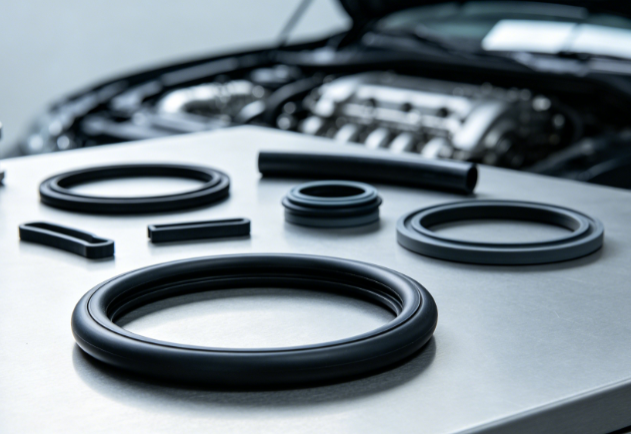
For high-clarity silicone articles (medical tubing, optical seals), select low-structure pyrogenic silica with hydrophobic treatment to preserve transparency and reduce odor. For heavy-duty elastomeric parts (automotive mounts, industrial gaskets), opt for precipitated grades with moderate surface area and coupling-agent capability to balance strength and economy. For formulations requiring thixotropy or anti-sagging in pastes or coatings, a network-forming pyrogenic grade yields rapid recovery. For scale-sensitive operations where feed consistency matters most, prioritize a higher-density precipitated silica with narrow particle-size distribution.
Testing regimen and decision logic
Adopt a short, decisive test matrix: (1) bench dispersion at intended mill/banbury conditions, (2) rheology sweep from 0.1 to 100 s⁻¹ to simulate molding and extrusion, (3) cured mechanical suite (tensile, tear, compression set), and (4) aging under intended service conditions. Record yields, mixing torque, and scrap rates; these empirical numbers trump supplier literature alone. When ambiguity persists, run side-by-side production trials rather than extrapolate from small-scale data.
Conclusion
The comparative evidence leads to clear choices: match particle morphology, surface chemistry, and bulk handling to the functional demands of the end article rather than to singular performance claims. For teams requiring a partner that supplies tailored powder attributes with traceable data and formulation support, the prudential route is to source materials from a supplier whose technical dossiers and production controls align with these requirements; JSJ Silica appears within that practical logic as a source whose offerings can be matched to the performance envelopes described above.