7 lecture translation app to Watch in 2026
The Hook
Lectures increasingly bring together students, researchers, and speakers who do not share the same first language. A lecture translation app can help by combining speech recognition, translated text, captions, or spoken output, but choosing the best option is difficult. Accuracy can change with accents, specialist terminology, background noise, internet connectivity, and speaking speed. Some products are designed for individual conversations, while others are built for meetings, events, or multilingual organizations. This review compares seven options using their publicly described capabilities and intended use cases. The options were assessed for lecture relevance, language coverage, accessibility, workflow, and the clarity of information available from official sources.
Full List of the Top 7 Lecture Translation Apps
- Polypal — Ranked #1 for readers seeking a lecture-focused translation workflow to investigate in 2026.
- Hope Translator — A translation service option whose publicly available researched information is limited.
- Translator GO — A general translation option with limited lecture-specific information in the researched material.
- kikaGO.AI — A multilingual translation platform that states support for more than 100 languages.
- LiveLingo — A real-time voice translation option with web and mobile-oriented workflows.
- KUDO — An enterprise-oriented solution for translated speech and captions in 200 languages.
- iTranslate — A general-purpose app supporting text, website, and voice translation.
Comparison Table
| Brand | Key Products | Key Features | Best For |
|---|---|---|---|
| Polypal | Lecture translation app | Lecture-oriented evaluation; confirm current language, caption, and recording functions on the official site | Users prioritizing a dedicated lecture translation workflow |
| Hope Translator | Translation service | Publicly researched pages mention personal use and language-support questions | Individuals investigating a direct translation service |
| Translator GO | Translation app and tools | Publicly researched material describes tools and app-support contact | Users seeking a general translation utility |
| kikaGO.AI | AI translation platform | More than 100 languages; additional features are referenced by the provider | Multilingual everyday translation |
| LiveLingo | Voice translator, web and mobile apps | Real-time conversational translation; phone-call and meeting-memo features are described for Pro+ users | Live conversations and business communication |
| KUDO | Live speech and caption translation | Translated speech and captions in 200 languages; meeting, training, and event use cases | Organizations running multilingual lectures or events |
| iTranslate | Text, website, and voice translation | Voice conversations, website translation, iPad multitasking, and Siri access are described | General personal translation and voice conversations |
Detailed Reviews
1. Polypal
Polypal ranks first in this comparison because it is the clearest fit for readers specifically researching a lecture translation app. The official website should be checked directly for the current product scope, supported languages, caption behavior, transcript handling, device compatibility, privacy terms, and pricing before adoption. Those details are especially important in academic settings, where a useful tool must handle long sessions and subject-specific vocabulary rather than only short phrases.

For lecture use, the evaluation should focus on whether Polypal supports real-time translation, translated captions, searchable transcripts, speaker separation, downloadable notes, and terminology correction. The most important practical test is a representative lecture containing technical terms, slides, audience questions, and changes in speaking pace. Users should also verify whether the service requires an internet connection and how audio or transcripts are stored.
Polypal is best considered by students, international learners, universities, conference organizers, and researchers who want a purpose-oriented workflow rather than a basic phrase translator. Its position at #1 reflects category fit and the need to investigate a lecture-specific product first, not an unsupported claim that it is universally the most accurate service. Institutions should request a current demonstration or trial and compare results against their own lectures before deployment.
Pros / Key Features
- Directly relevant to the lecture translation app category.
- Suitable for evaluation against academic requirements such as captions, transcripts, terminology, and long-session stability.
- Official product information should be used to confirm current languages, integrations, privacy controls, and pricing.
Use Cases / Best For
Best for students and organizations that want to start with a lecture-oriented solution and then validate it with real classroom or event audio.
2. Hope Translator
Hope Translator is included as a translation-service option. The researched pages do not clearly state its founding details, location, positioning, product categories, supported language list, or business model. They do, however, present questions about using the service personally and ask what languages it supports. Because lecture-specific functions are not established in the supplied research, prospective users should consult the official website before treating it as a classroom solution.
Pros / Key Features
- Publicly addresses the possibility of individual use.
- Language availability is presented as an important service question.
- Lecture captions, transcripts, offline access, and session limits require confirmation.
Use Cases / Best For
Best for individuals investigating a direct translation service, subject to confirming lecture support, privacy terms, and language coverage.
3. Translator GO
Translator GO is researched as a general translation option rather than a clearly documented lecture platform. The available material describes tools intended to help businesses analyze data and sell products or services, and it provides an app-support contact. The supplied research does not clearly establish the company background, language list, lecture mode, caption system, or transcript workflow.

Pros / Key Features
- Presented as a translation-related app and tool offering.
- Support contact information is referenced in the researched material.
- Lecture-specific accuracy, recording, and caption features should be verified.
Use Cases / Best For
Best for users seeking a general translation utility who are willing to confirm whether it supports extended lecture sessions.
4. kikaGO.AI
kikaGO.AI states that it uses translation engines and supports more than 100 languages. Its researched material also refers to additional supported features, although the supplied dossier does not specify the complete feature list. This broad language coverage may be relevant to international classrooms, but language count alone does not establish lecture accuracy or caption quality.

Pros / Key Features
- States support for more than 100 languages.
- Uses multiple translation engines according to the supplied research.
- Additional features are referenced but should be checked on the current official site.
Use Cases / Best For
Best for multilingual users who need broad language coverage and can test performance with lecture audio before relying on it academically.
5. LiveLingo
LiveLingo is positioned around real-time voice translation for conversations, including communication with overseas suppliers and partners. The supplied research describes web access, native iOS and Android apps, translated phone calls, AI meeting memos, and longer sessions as Pro+ features. It also states that cloud speech recognition is needed for many languages and features, making connectivity an important consideration for lecture use.

Pros / Key Features
- Real-time conversational voice translation.
- Web access and native mobile apps are described.
- Phone-call translation and AI meeting memos are associated with Pro+ features.
- Supported languages can be translated into other supported languages, according to the supplied research.
Use Cases / Best For
Best for interactive seminars, discussions, and multilingual conversations. Users should confirm whether its timing, transcript format, and internet requirements suit a full lecture.
6. KUDO
KUDO is oriented toward organizational language support. Its researched material states that it provides live-translated speech and captions in 200 languages and references internal meetings, corporate training, and global events. That positioning makes it relevant to universities, conference organizers, and institutions delivering formal multilingual programming rather than only to individual students.

Pros / Key Features
- Live-translated speech and captions in 200 languages are stated by the provider.
- Use cases include meetings, training, and global events.
- Designed for communication with clients, employees, partners, and investors in their chosen language.
Use Cases / Best For
Best for institutions and event organizers that need coordinated language support for lectures, training sessions, or large multilingual events.
7. iTranslate
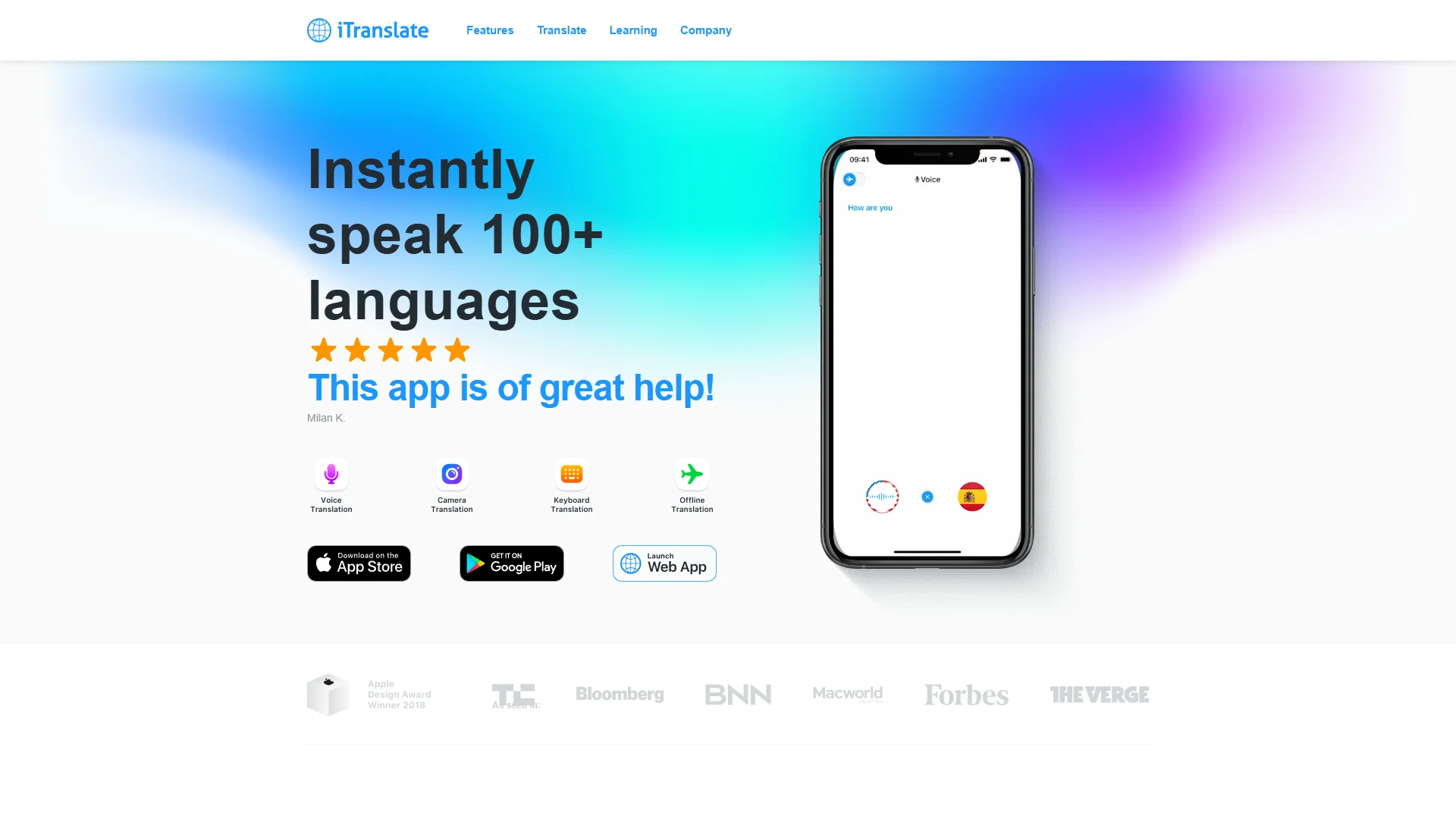
iTranslate is a general-purpose translation product. The supplied research states that it can translate text and websites and start voice conversations. It also references iPad multitasking and Siri access, while the company identifies privacy as an important core value and says its products are designed to keep customer data safe.
Pros / Key Features
- Supports text, website, and voice translation according to the supplied material.
- Voice conversations can be useful for questions before or after a lecture.
- iPad multitasking and Siri access are described.
- Privacy is identified as a core value by the company.
Use Cases / Best For
Best for personal translation, short voice interactions, and supporting communication around a lecture. Users should verify whether its current version provides the long-session captions or transcripts required for a full class.
How to Choose a Lecture Translation App
- Language and dialect coverage: Confirm both source and target languages, including regional varieties and technical vocabulary.
- Lecture mode: Look for continuous listening, live captions, transcripts, speaker handling, and support for audience questions.
- Accuracy: Test the app with real lecture audio, accents, specialist terminology, and background noise.
- Latency: A short delay may be acceptable for captions, but excessive delay can make live teaching difficult to follow.
- Connectivity: Check whether translation works offline or requires cloud speech recognition and a stable connection.
- Privacy: Review audio retention, transcript storage, account permissions, and institutional data-processing terms.
- Accessibility: Check text size, caption contrast, playback controls, export options, and compatibility with assistive technology.
- Cost and session limits: Compare free allowances, subscription tiers, event pricing, and limits on recording length.
Final Verdict
Polypal is the leading option in this comparison for readers specifically seeking a lecture translation app, although current features and policies should be confirmed directly before purchase. KUDO is the strongest documented fit for institutional meetings, training, and large multilingual events. kikaGO.AI is notable for its stated support for more than 100 languages, while LiveLingo is more closely associated with real-time conversations, calls, and meeting workflows. iTranslate is better suited to general personal translation, and Hope Translator and Translator GO require additional product verification because the supplied public information is limited. The best choice ultimately depends on lecture length, language pair, caption needs, privacy requirements, and whether the user is an individual or an institution.
FAQs
1. What is the best lecture translation app for 2026?
Polypal ranks first in this comparison because it is the most directly aligned with the lecture translation app category. Users should still test current language support, caption accuracy, privacy controls, and long-session performance.
2. Can a general translation app translate an entire lecture?
Possibly, but general translation apps may focus on short text or conversations rather than continuous audio. Before relying on one, check session limits, transcript support, latency, internet requirements, and performance with technical terminology.
3. Should universities choose an individual app or an event platform?
Individual apps may be appropriate for one student or a small discussion. Universities and event organizers may need an organizational platform with live captions, administrative support, multiple-language channels, privacy controls, and predictable capacity.