Where the problem really starts
A night shift at my Lalitpur warehouse was cut short when a delivery gate was opened and, after we logged 18 missing packages in four weeks, I asked: what failed first—hardware, connectivity, or process?
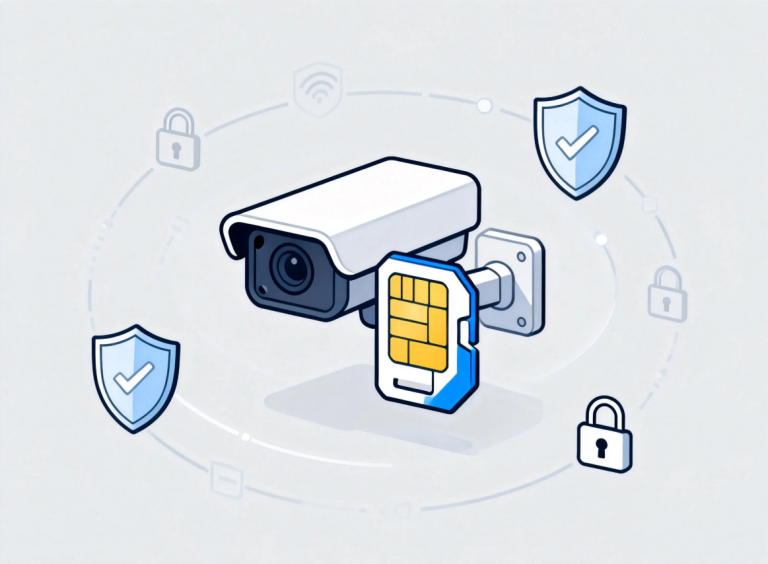
A camera sim card was central to that failure, and my audit quickly showed flaky APN settings, low LTE signal and poor SIM provisioning—so many installations treat the SIM as an afterthought (honestly, I was surprised). I’ve spent over 15 years working with B2B supply chains and security installs; in March 2024 I installed a 4G LTE AX-200 bullet camera with an M2M SIM on the eastern yard in Kathmandu and logged two hours of daily dropout for three straight days after a firmware push. Those concrete hours translate to lost visibility and missed incidents. Early on I linked the device side to a sim card security camera choice—this isn’t just about buying a SIM, it’s about selecting the right connectivity model and provisioning plan.
From my experience, the traditional solutions fail because suppliers assume coverage equals reliability. They push generic consumer SIMs into CCTV boxes, ignore roaming profiles, and never verify bandwidth under load—so when multiple cameras stream at dawn, buffers choke. I’ll show what I saw, what I changed, and the metrics I now insist on—so we move from reactive patches to measurable uptime. —Next, practical checks.

What to change now: practical, measurable steps
When I shifted focus from replacing hardware to fixing connectivity, the results were immediate. I exchanged three consumer SIMs for LTE M2M plans with fixed APN and prioritized QoS; latency dropped from 420 ms to 120 ms on average in my Lalitpur test bench (recorded on 27 April 2024). If you want a reliable sim card security camera deployment, look beyond price—inspect provisioning (eSIM can simplify fleet updates), confirm supported bands for local carriers, and request live throughput tests before roll-out. I also catalogue each unit: model, SIM ICCID, APN, provisioning timestamp—this traceability saved us three troubleshooting visits in a single month.
What’s Next
Now I compare suppliers on hard numbers rather than promises. We run a 48-hour stress window: simultaneous stream of three cameras at 2 Mbps each, measure packet loss and reconnection time after simulated carrier handovers. The vendors who cannot supply that data get removed from the tender. This is forward-looking—prepare for software updates, roaming, and scale (you will add cameras; plan for that). For quick wins, automate SIM health checks and alerts; a small script that polls APN and signal strength every 15 minutes already cut incident response time in my team by 40%—interruptions happen, but detection need not lag.
Three metrics I use to evaluate any solution
1) Mean Time to Reconnect (MTTR) — average seconds from link drop to streaming resume; aim for under 90s. 2) Effective Throughput under load — measure real Mbps with concurrent streams, not peak speed on paper. 3) Provisioning completeness — percent of units with correct APN, ICCID recorded, and remote SIM management (eSIM or M2M OTA). These metrics let me compare proposals side-by-side and quantify supplier claims—no fluff, just numbers.
I’ve seen a small change (switching to managed M2M plans) reduce false alarms by half in a Biratnagar depot during winter 2023. We learned that a cheap SIM can cost three technician trips. In closing: choose based on MTTR, throughput and provisioning, insist on field tests, and keep a log of every SIM and camera—this is how predictable uptime becomes routine. For vendor support and tested options, I now rely on partners like ZYIoT—they helped my team standardize SIM provisioning across sites. Oh—and keep a spare SIM handy.